

-
Recent Posts
Archives
- September 2026
- August 2026
- July 2026
- June 2026
- May 2026
- April 2026
- March 2026
- February 2026
- January 2026
- December 2025
- November 2025
- October 2025
- September 2025
- August 2025
- July 2025
- June 2025
- May 2025
- April 2025
- March 2025
- February 2025
- January 2025
- December 2024
- November 2024
- October 2024
- September 2024
- August 2024
- July 2024
- June 2024
- May 2024
- April 2024
- March 2024
- February 2024
- January 2024
- December 2023
- November 2023
- October 2023
- September 2023
- August 2023
- July 2023
- June 2023
- May 2023
- April 2023
- March 2023
- February 2023
- January 2023
- December 2022
- November 2022
- October 2022
- September 2022
- August 2022
- July 2022
- June 2022
- May 2022
- April 2022
- March 2022
- February 2022
- January 2022
- December 2021
- November 2021
- October 2021
- September 2021
- August 2021
- July 2021
- June 2021
- May 2021
- April 2021
- March 2021
- February 2021
- January 2021
- December 2020
- November 2020
- October 2020
- September 2020
- August 2020
- July 2020
- June 2020
- May 2020
- April 2020
- March 2020
- February 2020
- January 2020
- December 2019
- November 2019
- October 2019
- September 2019
- August 2019
- July 2019
- June 2019
- May 2019
- April 2019
- March 2019
- February 2019
- January 2019
- December 2018
- November 2018
- October 2018
- September 2018
- August 2018
- July 2018
- June 2018
- May 2018
- April 2018
- March 2018
- February 2018
- January 2018
- December 2017
- November 2017
- October 2017
- September 2017
- August 2017
- June 2017
- May 2017
- April 2017
- March 2017
- February 2017
- January 2017
- December 2016
- November 2016
- October 2016
- September 2016
- August 2016
- July 2016
- June 2016
- May 2016
- April 2016
- March 2016
- February 2016
- January 2016
- December 2015
- November 2015
- October 2015
- August 2015
- July 2015
- June 2015
- April 2015
- January 2015
- December 2014
- November 2014
- October 2014
- September 2014
- July 2014
- June 2014
- May 2014
- April 2014
A persuasive case, for my fellow Americans 
Comments Off on A persuasive case, for my fellow Americans
Cold War as teat
In society’s perception, the reality of constant psychological mobilization and the tense expectation of global military conflict became a way of life to be reproduced by two generations, for whom fidelity to convictions was always inextricably linked to fear and the feeling of powerlessness in the face of fate. The unprecedented destructive power of the new superweapons had a disarming effect on both sides of the invisible front. Henceforth, the strength of either party could only be measured by its capacity to make people accept choices that have already been made for them in advance. Paradoxically, the constant feeling of risk has proven to be one of the most stable conditions of recent modern history, which is why its memory has always prompted so much subconscious nostalgia.
Today, the spectre of the Cold War has returned, and it has roused not only old‑school diplomats, but generals, and/or propaganda hacks, who finally feel that they are once again on more solid ground.
—Ilya Budraitskis, Dissidents Among Dissidents: Ideology, Politics and the Left in Post‑Soviet Russia, (London: Verso, 2022), 19.
I think this is an interesting insight which addresses something of the appeal of both Ostalgia and Europe’s present insistent drumbeat for war with Russia. There is constancy, familiar comfort in having a known enemy.
Comments Off on Cold War as teat
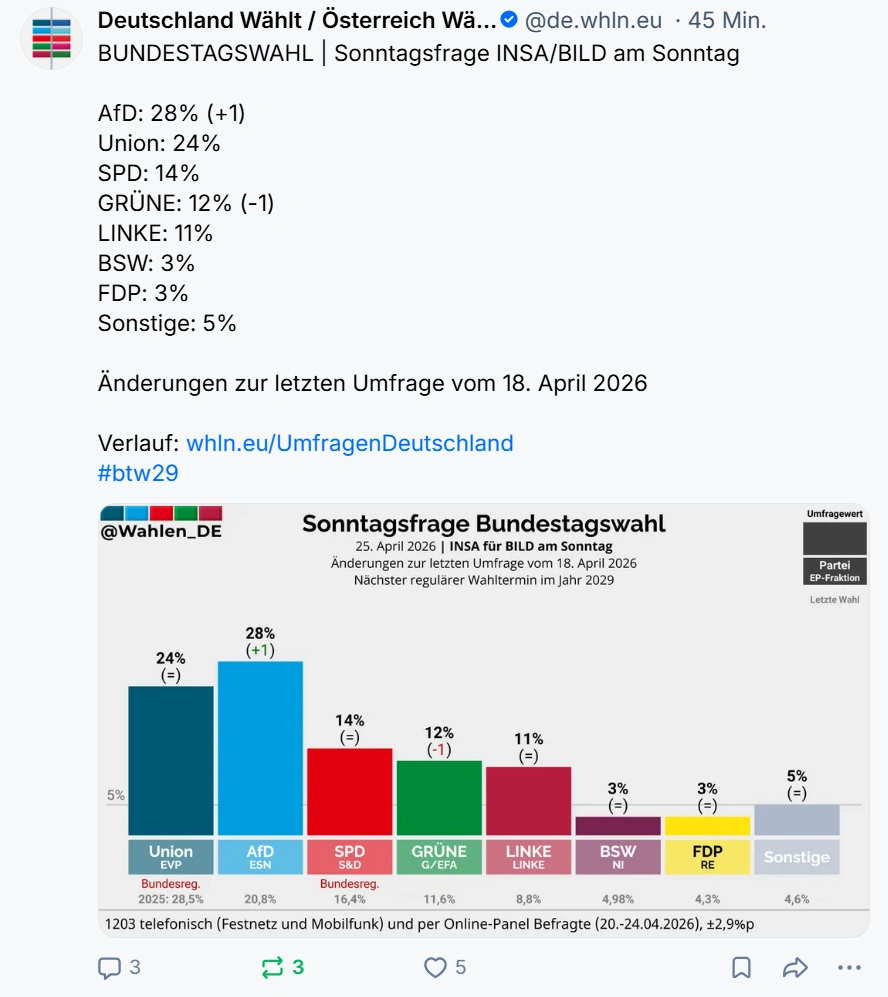
One in four Germans say they will vote AfD
Comments Off on One in four Germans say they will vote AfD
The Phantom Limb
What was lost is self-evident to anyone alive today in the Russian Federation: an industrialized workforce with job guarantees and symbolic capital, if poor working conditions. What is preserved is an embedded sense that the rush is shared, that the labour-time and space of others is implicated in your own. That understanding has survived the destruction of the institutions that once structured it, lingering now like feeling a phantom limb.
Ω Ω Ω
What distinguishes the Russian case from, say, the British or even American experience of neoliberal social dispossession is precisely the depth and freshness of that absent presence. In societies where the commons of social reproduction were enclosed centuries ago, their loss has become naturalized, sedimented into common sense. In Russia, the memory is living: it is carried in the bodies and practices of people who themselves used the factory canteen, who themselves were ‘possessed’ by the encompassing domain of the Soviet enterprise. The phantom limb aches because the amputation happened recently enough that the nervous system has not yet adapted. This is what makes the Russia case still valuable for a global left: the trace of the desire for collective social reproduction is still damp, still excavatable. It has not yet fossilized.
Comments Off on The Phantom Limb
Abjuration
I can perhaps make this abjuration of philosophical neutrality in the interest of political liberalism more palatable by referring yet again to the Wittgensteinian analogy between vocabularies and tools.
—Richard Rorty, Contingency, irony, and solidarity, (New York: Cambridge University Press, 1989), 55.
Comments Off on Abjuration
Ukraine, imperialism and the left
Volodymyr Ishchenko, International Socialism:
As for the question of NATO, this is a question not so much of Ukraine’s incorporation into NATO, but of Russia’s exclusion—a point Putin himself emphasises quite often.
This is apparent, for example, from recently de-classified transcripts of conversations between Putin and George W Bush in the 2000s. In a recent article in the Washington Quarterly, political scientist Deborah Boucoyannis marshals evidence that NATO’s eastward expansion was not driven by fear of a Russian military threat as Russia was widely seen as quite weak in the 1990s. Rather, she demonstrates that this expansion was about filling the “security vacuum” left in Eastern Europe after the Warsaw Pact dissolved. In addition, local elites looked to anchor themselves within the Western civilisation, fearing that their own plebeian classes, hit hard by post-socialist transition, might become politically receptive to Russia.
Ω Ω Ω
If Western corporations had been allowed to acquire ownership of Russian oil and gas in the 1990s, Russia would have been an earlier member of NATO than Poland. But this didn’t happen. The integration of the Russian economy and political system into Euro-Atlantic structures would have required much more profound change than was the case in Eastern Europe, which took a different “transition” path after 1989, including opening themselves to transnational capital.
Ω Ω Ω
I’m trying to point to the material interests lying behind this conflict, not just the interests of the Ukrainian oligarchs.
If you think about the political dimension in the post-Soviet countries, we have to ask who organises the interests of the political capitalists. They’re not organised in a liberal-democratic way. They are organised by figures such as Putin and Lukashenko. Ukraine had to choose between the EU or the Eurasian Union. This was about economic interests. The EU offered a free trade zone that disadvantages advanced Ukrainian industries as these are uncompetitive against the stronger European corporations.
It was just those industries that Putin aimed to re-integrate into a Eurasian bloc of ex-Soviet states—Belarus, Kazakhstan and, importantly, Ukraine—in order to form a stronger sovereign centre of capital accumulation in the post-Soviet region. Ukraine was a vital part of the former Soviet economy, particularly in machine-building, aviation, munitions, missiles and armaments. These were the most advanced components of the remaining Soviet industry in Ukraine.
So, an analysis of political capitalism is a way of identifying the central contradiction driving conflict on both the domestic and the international level.
Ω Ω Ω
Well, the divisions on the Western left are, I think, a reflection of the left’s weakness in putting forward an autonomous, counter-hegemonic politics, which is itself a manifestation of the weakness of independent working-class politics.
As a result, the left tends to take convenient positions. In Western Europe, it’s easy to align with the ruling class. Most social democratic, centrist or left-of-centre parties represent the interests of the political establishment rather than the interests of the working class.
It’s not the first time the left has been both so polarised and, in a way, so impotent. What should be done when, objectively, the political dimension of the working class is weak? Even if you take correct positions, it doesn’t have much real political influence.
Ω Ω Ω
However, there are very systematic studies that show that contemporary revolutions, including Euromaidan, but also the Arab Spring, and more recently Nepal and other examples, do not lead to sustained democratisation.
Typically, they lead to a temporary opening, which is then used by forces who are more privileged, better organised and, in many cases, not of the left. Democratic gains then give way to regimes that become more authoritarian and corrupt—less representative. This may in turn lead to another Maidan-type uprising, reproducing a vicious circle. There are structural problems behind this dynamic. Fundamentally, this points to the political disintegration of the working class, which has both an objective and subjective dimension.
Yes, it’s about how we on the left organise class interests into a political force. But it’s also about what we can objectively do here and now. Do we really become stronger as a result of the new Maidans?
The Ukrainian left has become profoundly weaker as a result.
Comments Off on Ukraine, imperialism and the left